As industrial bakeries expand production of croissants, puff pastries, laminated buns, and other flaky products, maintaining consistent dough quality at high production speeds remains a major challenge. Much depends on how the dough is handled during sheeting and lamination. Excessive pressure, uneven thickness reduction, or poorly synchronized conveying can affect dough elasticity, disrupt fat layers, and lead to inconsistent finished products.
Low-stress dough sheeting helps address these issues by controlling how dough is compressed, stretched, and transferred throughout the production process. For manufacturers investing in a Multi Functional Dough Laminating Line, the goal is not simply to produce thinner dough sheets at higher speeds. It is to maintain a stable dough structure while achieving the required thickness, layer count, and product dimensions. Understanding how mechanical stress affects dough can help bakeries improve process consistency, reduce waste, and achieve more reliable production results.
Dough is a viscoelastic material, meaning it deforms under mechanical force and can partially recover its original shape once that force is removed. During industrial sheeting, dough passes through rollers that gradually reduce its thickness. While this process is essential for producing uniform sheets, excessive compression or stretching can place unnecessary stress on the gluten network.
One common result is dough retraction, also known as elastic recovery. After passing through a sheeting station, the dough may shrink or change shape as its gluten structure responds to mechanical deformation. This can create problems during subsequent folding, cutting, and forming operations. Uneven pressure across the sheet may also cause thickness variations, while excessive mechanical working can contribute to tearing and irregular edges.
These issues are particularly significant in laminated pastry production, where dough and fat must remain in distinct, well-distributed layers. Uneven stretching or excessive compression can affect fat distribution and compromise the structure needed to produce a light, flaky texture after baking.
Low-stress dough sheeting aims to minimize unnecessary mechanical deformation while applying enough pressure to achieve the required sheet dimensions. Instead of reducing the dough to its final thickness in one aggressive step, manufacturers can use controlled, progressive sheeting to maintain a more stable dough structure.
Maintaining Consistent Dough Thickness
Gradual thickness reduction helps produce a more uniform dough sheet across its entire width. Consistent dimensions are especially important before folding and cutting, as thickness variations can affect the weight, shape, and appearance of finished products.
Preserving Dough and Fat Layers
In laminated products, dough and fat need to remain in separate, continuous layers. Excessive compression can cause fat to spread unevenly or disrupt the separation between layers. Properly controlled sheeting helps preserve the structure required for consistent expansion during baking.
Reducing Dough Retraction and Tearing
Appropriate pressure, synchronized conveyor movement, and suitable processing conditions help limit unnecessary stretching and deformation. This allows the dough to maintain more stable dimensions as it moves between production stages.
Improving Finished Product Consistency
When dough enters downstream folding and forming equipment with uniform thickness and stable dimensions, manufacturers can achieve better control over product size, layer distribution, and overall appearance.
Low-stress processing does not mean eliminating mechanical pressure. It means applying pressure progressively and adjusting operating conditions to suit the characteristics of the dough.
Several processing variables influence how dough responds to industrial sheeting. Equipment design plays an important role, but recipe formulation and operating conditions also affect the final result.
The roller gap determines how much the dough thickness changes during each sheeting stage. If the reduction is too aggressive, the dough may experience excessive deformation, leading to elastic recovery, uneven edges, or damage to the laminated structure.
For multi-stage processing, gradually reducing the dough thickness is generally preferable to forcing a thick sheet through a single high-pressure stage. The appropriate reduction depends on the dough formulation, initial thickness, gluten properties, and required product structure.
The relationship between roller speed and conveyor speed directly affects dough tension. If the conveyor and rollers operate at mismatched speeds, the dough may accumulate, stretch, or become unevenly distributed.
In continuous production, synchronized movement helps maintain a stable dough sheet and ensures smooth transfer between processing modules. When selecting an industrial dough sheeting line, manufacturers should pay attention to speed adjustment, transfer design, and coordination between different sections.
Temperature control is particularly important in laminated pastry production. Dough that is too warm may become sticky and difficult to handle, while excessively cold or firm dough may resist deformation and develop cracks.
The fat used for lamination must also maintain suitable plasticity. If it is too soft, it may spread into the dough instead of forming distinct layers. If it is too firm, it may break during sheeting and folding.
Keeping dough temperature and fat consistency within suitable processing ranges helps preserve layer integrity throughout lamination.
Flour protein content, water absorption, mixing conditions, and resting time all influence dough elasticity and extensibility. Dough with excessive elastic resistance may retract after sheeting, while dough with insufficient structural strength may tear during continuous processing.
Different pastry recipes therefore require different processing conditions. Equipment settings should be adjusted to suit the actual dough formulation rather than applying the same parameters to every product.
In an automated bakery, dough passes through several interconnected stages, including feeding, sheeting, fat application, folding, thinning, cutting, and forming. A problem in one section can affect the performance of the entire production line.
An integrated industrial laminating system distributes these operations across dedicated mechanical modules. Continuous dough sheeting forms the initial dough web, while edge rolling helps refine its side portions. A grease extrusion system supplies continuous fat strips, and a butter-encasing conveyor wraps the fat within the dough before the folding stages.
Folding technology also plays a major role in determining the final layer structure. An oscillating folding mechanism arranges dough into a continuous Z-pattern, while a reciprocating laminating mechanism creates multiple overlapping layers through controlled back-and-forth movement. Depending on the product and machine configuration, these methods can accommodate different lamination requirements.
After folding, transverse rolling, paired-roller thinning, and planetary gear reduction further process the dough sheet. Dividing thickness reduction and layer formation into several controlled stages gives manufacturers better control over the transition from a thick laminated structure to the required final sheet dimensions.
This integrated approach is particularly useful for bakeries producing different laminated products, as it allows dough handling and processing conditions to be adjusted to suit different product specifications.
For overseas bakery manufacturers, choosing a production line involves more than comparing maximum output figures. The equipment must match the intended products, dough characteristics, factory layout, and long-term production requirements.
Several technical factors deserve careful consideration:
Dough Sheet Width and Thickness: Check whether the equipment can accommodate the required sheet dimensions and thickness range.
Lamination Capability: Evaluate the available folding methods, fat application system, and achievable layer configurations.
Production Capacity: Compare the rated output with the actual requirements of the intended dough formulations and products.
Speed Synchronization: Check how the feeding, sheeting, folding, and conveying sections coordinate during continuous operation.
Product Flexibility: Determine whether different pastry products can be manufactured through adjustments or component changes.
Cleaning and Maintenance: Consider access to food-contact components, cleaning procedures, and the time required for routine maintenance.
Factory Integration: Evaluate equipment dimensions, installed power, compressed air requirements, and compatibility with upstream mixing and downstream baking systems.
Buyers should also request production trials using their own dough recipes whenever possible. A line that performs well with one formulation may require different operating parameters for another. Testing actual samples provides a more reliable basis for evaluating product quality and achievable output.
HEXEON, operating under Hengjiang Intelligent Technology Co., Ltd., develops automated food machinery and bakery production lines for commercial and industrial applications. Its Multi-functional Dough Lamination & Formation Line integrates several processing modules in a modular Z-configuration, supporting continuous dough processing, multi-layer lamination, and product forming.
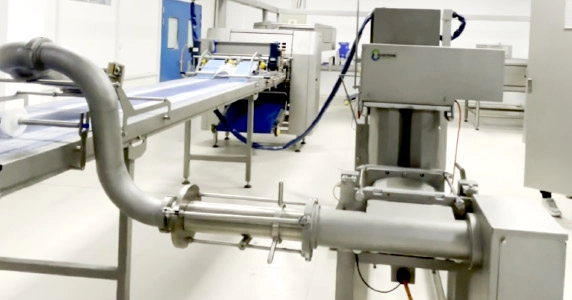
The line features a Low-Stress Continuous Dough Sheeting System designed to form a continuous dough sheet through controlled sheeting. This is followed by an edge rolling mechanism, grease extrusion pump, and butter-encasing conveyor. Together, these components prepare the dough for subsequent folding and thinning operations.
For layer formation, the equipment incorporates oscillating folding and reciprocating laminating mechanisms. Depending on the selected configuration, it can produce approximately 10–100+ dough layers through fat encasing, swing folding, and draw folding techniques. Additional modules include transverse rolling, counter-roller skinning, planetary gear reduction, flour brushing, rotary cutting, and filling injection.
The production line offers effective dough sheet widths of 600, 800, 1,000, and 1,200 mm, with a published thickness range of 1.5–20 mm. Its listed maximum dough output capacity is 1–2.6 tonnes per hour, depending on configuration, while forming speed can reach 150 cycles per minute.
The modular design supports the production of croissants, hand-torn buns, laminated dough sheets, durian puffs, cheese puffs, and other laminated pastry products. With adjustments or changes to selected components, manufacturers can adapt the line to different product requirements without investing in entirely separate production systems.
The control system also supports operation through a built-in touchscreen, smartphone, tablet, or PC. Quick cleaning and product changeover features further help manufacturers manage routine production and equipment utilization.
For bakeries planning to expand their laminated pastry production, integrating controlled sheeting, flexible folding, and automated forming offers a practical way to balance product consistency with manufacturing efficiency.
1. What is low-stress dough sheeting?
Low-stress dough sheeting is a controlled thickness-reduction process designed to minimize unnecessary compression, stretching, and deformation. It helps maintain dough structure and improve dimensional consistency during industrial bakery production.
2. Why does dough shrink after sheeting?
Dough shrinkage is commonly caused by elastic recovery within the gluten network after mechanical deformation. Flour properties, hydration, mixing conditions, resting time, and the degree of thickness reduction can all influence this behavior.
3. How does roller gap affect laminated dough quality?
The roller gap determines how much the dough thickness is reduced at each processing stage. Excessive reduction may damage the dough structure or disturb fat layers, while properly adjusted gaps help maintain uniform sheet thickness and layer integrity.
4. Why is temperature control important in laminated dough production?
Temperature affects both dough extensibility and fat plasticity. If the dough becomes too warm or the fat becomes too soft, distinct layers may be difficult to maintain. Suitable temperature conditions help preserve the structure needed for flaky pastry products.
5. How many layers can an industrial dough laminating line produce?
The achievable layer count depends on the folding method, equipment configuration, and product requirements. HEXEON's multi-functional dough lamination line supports approximately 10–100+ layers through fat encasing, oscillating folding, and reciprocating folding techniques.
6. What should manufacturers check before purchasing a multi-functional dough laminating line?
Manufacturers should evaluate dough compatibility, sheet width, thickness range, lamination capability, output capacity, speed control, product flexibility, cleaning requirements, and factory integration. Production trials using the intended dough recipe can help verify actual performance.
Low-stress dough sheeting plays an important role in laminated pastry production because the quality of the initial dough sheet affects every subsequent processing stage. By controlling thickness reduction, dough tension, temperature, and fat distribution, manufacturers can better preserve layer integrity and achieve more consistent results.
For industrial bakeries looking to expand production or improve product flexibility, a multi-functional dough laminating line offers an integrated solution. Combining continuous sheeting, multi-layer folding, and automated forming in one system helps streamline production while meeting the demands of different laminated pastry products.