As industrial bakeries expand their production capacity, reducing raw material waste has become an important factor in controlling manufacturing costs. In high-speed sausage bread production, even small variations in dough thickness, cutting dimensions, or sausage positioning can lead to excessive trimming, inconsistent product sizes, and rejected pieces. For manufacturers operating continuous production lines, these problems can accumulate into significant material losses over time.
A well-designed Sausage Roll Production Line helps address these challenges by integrating dough sheeting, thickness adjustment, cutting, automatic sausage feeding, wrapping, and product transfer into a coordinated process. Rather than focusing only on production speed, manufacturers need to consider how each processing stage affects dough utilization, product consistency, and overall line efficiency.
Dough waste in industrial sausage bread manufacturing usually results from several interconnected production problems. Uneven dough thickness is one of the most common causes. When a dough sheet is not uniform, some portions may become too thick while others are too thin. This affects the amount of dough used in each product and can create difficulties during wrapping and baking.
Inaccurate cutting is another contributing factor. If the dough pieces are larger than required, more material is consumed for each sausage roll. If they are too small, the dough may not cover the sausage properly, increasing the risk of exposed filling, poor wrapping, and product rejection.
Production interruptions and inconsistent material feeding can also increase waste. When dough conveying, cutting, sausage placement, and wrapping are not properly synchronized, products may become misaligned or deformed. Therefore, reducing dough waste requires a systematic approach that addresses the entire production workflow rather than optimizing a single machine.
Dough sheeting is a critical stage in controlling material consumption. A uniform dough sheet provides a stable foundation for subsequent cutting and wrapping operations. If thickness varies across the sheet, manufacturers may need to increase the overall dough allowance to avoid portions that are too thin, resulting in unnecessary material consumption.
A more controlled sheeting process uses gradual compression instead of reducing the dough thickness through one aggressive operation. Roller gaps, pressure distribution, dough feeding speed, and dough characteristics should be considered together. Excessive compression may cause dough deformation, while insufficient or uneven pressure can result in inconsistent thickness.
In an industrial Sausage Roll Production Line, low-stress dough compression, planetary gear mechanisms, and horizontal compression systems can work together to improve dough thickness uniformity. Additional equalization mechanisms help prepare the dough sheet for accurate cutting and forming.
HEXEON incorporates these types of processing mechanisms into its sausage roll formation line. By combining multiple dough-thinning and shaping stages, the equipment is designed to support more consistent dough preparation before the material enters the cutting and wrapping sections.
After sheeting, dough alignment and cutting accuracy directly affect material utilization. Consistent dough width and positioning allow manufacturers to produce rectangular dough pieces with dimensions suited to the required sausage size.
Excessive trimming often occurs when the dough sheet is wider than necessary or when cutting positions are inconsistent. To reduce unnecessary offcuts, manufacturers should establish suitable dough dimensions according to the sausage length, diameter, desired dough coverage, and wrapping requirements.
The cutting mechanism must also operate in coordination with conveyor movement. If cutting timing does not match the dough feeding cycle, the resulting pieces may have inconsistent lengths or spacing. This can affect both material consumption and the stability of downstream sausage placement.
HEXEON's sausage roll formation line includes a motion cutting mechanism designed to form individual dough pieces. Combined with its dough alignment and thickness adjustment sections, this configuration supports a more organized transition from continuous dough sheets to individual portions.
Accurate sausage placement is essential for reducing rejected products. When sausages are positioned incorrectly on dough pieces, the wrapping process may produce uneven seams, exposed filling, or inconsistent product shapes. Such defects can result in additional material loss and reprocessing.
Manual placement becomes increasingly difficult to maintain at high production volumes because operators must repeatedly control sausage position, orientation, and spacing. An automatic feeding system can improve positioning consistency by coordinating the placement cycle with dough conveying and forming operations.
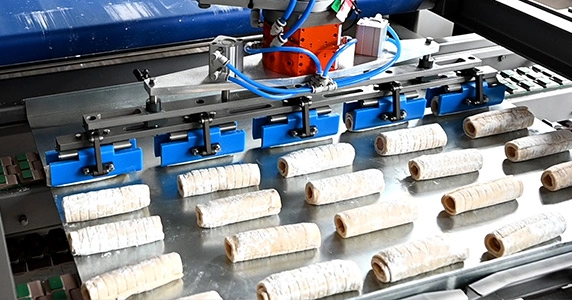
HEXEON's Sausage Roll Production Line features a dual-group automatic feeding mechanism that places sausages onto pre-cut rectangular dough sheets. The sausages are then wrapped in dough, while robotic handling supports the transfer of finished products to trays.
For stable operation, the feeding speed, conveyor timing, dough-piece spacing, and wrapping cycle must be properly coordinated. Manufacturers should also consider sausage dimensional tolerances and variations in dough properties when configuring the production process. Consistent filling placement helps reduce forming defects and unnecessary product rejection.
High production speed does not automatically mean better material efficiency. If a production line operates faster than its dough feeding, cutting, or wrapping mechanisms can reliably handle, dimensional deviations and product defects may increase.
A more effective strategy is to balance the operating speed of each processing section. Dough sheeting should provide a continuous and stable supply, cutting should maintain consistent piece dimensions, and automatic sausage feeding should match the movement of the prepared dough pieces.
Manufacturers should monitor several operating factors, including conveyor speed, cutting frequency, dough thickness, product spacing, and feeding synchronization. Regular inspection of rollers, cutting components, conveyor systems, and positioning mechanisms can also help prevent gradual deviations during extended production runs.
An integrated control system makes it easier for operators to manage production settings and monitor key operating processes. HEXEON provides a visual touchscreen interface and a self-developed operating system for equipment operation and process control, supporting convenient management of the production line.
Equipment optimization is only one part of dough waste reduction. Production management also plays an important role. Manufacturers should identify where material losses occur and distinguish between avoidable process waste, reusable dough scraps, and products that must be rejected.
For example, offcuts generated during dough cutting may be considered for controlled reuse if their condition, processing history, formulation, and food safety requirements permit it. However, not all dough scraps are suitable for reprocessing. Dough that has been contaminated, excessively handled, or exposed to unsuitable conditions should be managed according to the factory's food safety procedures.
Manufacturers can also establish a material monitoring system to record dough input, finished product output, trimming volume, and rejected products. These records help identify recurring problems and provide a basis for adjusting dough dimensions, roller settings, cutting parameters, and production schedules.
Combining process monitoring with preventive maintenance helps maintain stable equipment performance and reduces avoidable losses caused by mechanical wear or incorrect settings.
For food manufacturers planning to upgrade or expand their production capacity, selecting the right Sausage Roll Production Line requires more than comparing maximum output figures. Equipment configuration, dough processing accuracy, automation level, and compatibility with existing bakery operations should all be evaluated.
Important considerations include:
Dough processing capability: Check whether the equipment supports the required dough types, feeding formats, thickness adjustments, and forming conditions.
Cutting precision: Evaluate how accurately the machine controls dough dimensions and whether cutting settings can accommodate different product specifications.
Automatic sausage feeding: Consider feeding accuracy, product spacing, and synchronization with the dough conveying and wrapping systems.
Production capacity: Match the line's rated capacity with actual product weight, size, operating schedules, and downstream processing requirements.
Cleaning and maintenance: Examine cleaning accessibility, routine maintenance requirements, and the availability of technical support.
Production integration: Confirm compatibility with existing proofing, baking, freezing, tray handling, and packaging processes.
HEXEON's sausage roll formation solution integrates dough sheet production, thickness and width adjustment, final forming and cutting, dual-group automatic sausage feeding, wrapping, and robotic tray transfer. The company also provides automated bakery production equipment for other applications, including pastry, croissant, egg tart, donut, pizza, and pie production.
This integrated equipment approach is intended to help industrial bakeries move toward more standardized production, reduce repetitive manual handling, and improve coordination between processing stages.
The main causes include uneven dough thickness, inaccurate cutting, inconsistent dough feeding, and incorrect sausage positioning. Improving process coordination and equipment accuracy can help reduce unnecessary trimming and rejected products.
An automated production line can improve dough utilization through controlled sheeting, accurate cutting, consistent product positioning, and synchronized forming operations. These processes help reduce dimensional variations and unnecessary material loss.
Yes. Automatic sausage feeding helps maintain consistent filling positions and reduces errors associated with repetitive manual placement. This can minimize forming defects and improve product consistency during continuous production.
Consistent dough thickness helps maintain product weight, wrapping quality, and baking consistency. It also reduces the need for excessive dough allowances and helps ensure that each dough portion meets the required specifications.
Manufacturers should evaluate dough processing accuracy, cutting precision, automatic feeding, production capacity, cleaning requirements, maintenance accessibility, and compatibility with existing bakery equipment. The production line should also match the required sausage dimensions and product specifications.
Reducing dough waste in high-speed sausage bread production requires coordinated improvements throughout the manufacturing process. Uniform dough thickness, accurate cutting, consistent sausage positioning, and synchronized forming operations all contribute to better material utilization.
For industrial bakeries, the objective should not simply be to increase machine speed, but to maintain stable production quality while minimizing unnecessary material consumption. Choosing an appropriately configured Sausage Roll Production Line, together with effective process monitoring and regular equipment maintenance, can help manufacturers achieve more consistent and cost-conscious production.
As a manufacturer of automated bakery production equipment, HEXEON develops integrated forming and handling solutions for industrial food manufacturers. Its sausage roll formation line combines dough processing technology with automatic feeding and robotic handling to support the growing demand for efficient, consistent, and scalable bakery production.